Showing posts with label food and art. Show all posts

Tuesday, October 04, 2016

Chef Dali


How did I not know that Salvador Dali wrote a cookbook? And threw "lavish dinner parties" with his wife, Gala?
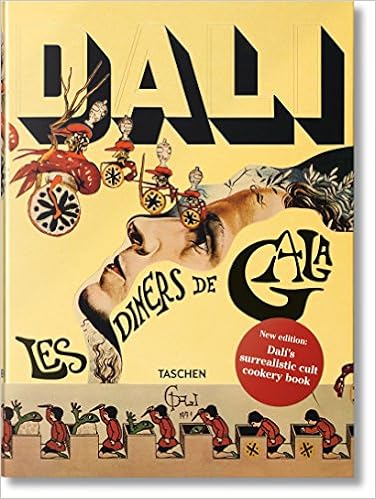
Well, I know now...and I also know what I want for Christmas. Taschen is publishing Dali's 1973 cookbook, Les Diners de Gala...and I want a copy. It sounds insane and fabulous and exactly like what you'd imagine Salvador Dali's cookbook + 1973 would, could and should be.

Buy it (for me) here.

Saturday, December 28, 2013

I Make Grocery Lists

Lots of them. But my lists don't look like this:
Because I am not Michelangelo.

Tuesday, November 20, 2012

Late Night at the BMA

Last Saturday night was the party celebrating the opening of the BMA's new contemporary wing. Cooper and I were there and it was kind of wild. So many people, so much chatter.

The wing was extremely cool, too. One of the new artists, Sarah Oppenheimer, has created these interesting architectural nooks that allow people to look through the galleries in unusual ways (like windows that allow you to see three galleries at once). The effect is really cool - for me, it's interesting thinking about how the people curating the exhibit had to consider the way the art would work not only with the other pieces in the room, but also with the visible pieces in the other rooms.

I gave a little talk - to a very small, but engaged audience - on the intersection between food and art. I stood next to the work on the left - a 2010 photograph by the artist Elad Lassry, called "Cherries, Raspberries, Blackberries (Marbled)".

Below, I've included the text of my talk. It's mostly culled from things I've already written here...turns out, I've written a loooot about food and art!

Food and art has always been a favorite topic of mine – there are so many similarities between the food world and the art world and much overlap between the two.

I find art history fascinating. Studying art is such a good way to explore a culture. When you look at art from a particular time period, or from a certain place, you can learn so much about what’s going on there politically, economically, socially.

It’s a window to the culture.

Food is the same. Looking at what people eat, how they cook, how they get their food, how they share meals – it’s a great way to learn about a culture or about a period in history.

So I’m standing here in front of this photograph, called “Cherries, Raspberries, Blackberries (Marbled).”

It’s a 2010 work by Elad Lassry, a 35-year old Israeli-born artist who has lived in LA since he was 20.

Lassry works primarily in photographs, with some film thrown in. He photographs a diverse range of subjects – food, animals, portraits, objects.

But he does have a few consistent signatures – the painted frames and the size and shape of the images. Lassry confines himself to traditional magazine dimensions.


His images are representational, but he plays with effects to modernize them. In a 2011 Art AsiaPacific article, writer William Pym described Lassry’s works as “twinkling with formal effects.” I think that’s a good description of what you see here – the fruit does seem to twinkle.

A work similar to this one – the same fruit arrangement on a stark white background – Pym described as “a study in the palette of blood colors.” And about this work, he said Lassry “plays the same glossy bruise colors against a smeared red.”

I love the phrases “blood colors” and “bruise colors” – when I look at this photograph, I see the colors of life. The fruit is bright, vibrant, full of vitality. There’s a very easy “food is life” metaphor in the photograph. This photograph depicts life in its ripe prime.

But in the next room, an Untitled work by Zoe Leonard uses the same metaphor but in a different way. The artist ate fruit and sewed the skins together, leaving them to decompose. The message is one of decay – the end of life.

Leonard and Lassry’s works are part of a long history of featuring food as the subject of art. From still lifes to parties to meals, food as been a regular subject of artists forever. Even the earliest artists – cave painters – drew animals. Their food.

But there are also twistier ways that food becomes art.

On her Tumblr “Low Commitment Projects,” artist Brittany Powell featured sandwiches designed as tributes to her favorite artists. It’s funny and cool. My favorite is the Mondrian. Slices of cheese and meat create his famous grids. It lends itself surprisingly well to a sandwich. It's less surprising how well it lent itself to the internet.

People all over America look to famous artworks as inspiration for cakes, and cookies. I’ve seen Rothko cookies and van Gogh cakes. They’re great.

Brooklyn artist Vik Muniz created a Mona Lisa out of peanut butter and jelly.

What Muniz did isn’t new, either.

During the Renaissance, there was an organization called the Company of the Cauldron. It was sort of a sophisticated, artsy dinner club, with members like Michelangelo and da Vinci. The club had legendary parties and to get in, you had to bring a type of “edible art.” Art, created out of food, designed to be eaten.

Something like the Company of the Cauldron is uncontroversial in the art world. Everyone understands that the artist is using food to create art and no one takes it too seriously.
 

But when you move into the food world, where the chef is the creator, there’s more drama.

There are two camps in the food world. Those who consider food food – sustenance – and nothing more.  They may respect it, but they do not intellectualize it.

Then there are those who think food has the potential to be more. To start conversations. To be intellectualized. To be art.

Food is a functional substance – we need it to survive. And anytime function comes into play, things get messy.

A few weeks ago, I had a conversation with a furniture maker here in Baltimore, named Sean O’Harra.

Sean makes beautiful tables and benches and bowls from reclaimed woods and metals. He studied sculpture at MICA and furniture design at VCU.

During our conversation, I asked him if he considered himself an artist. He said yes, but sort of laughed.

He told me that during college and grad school, he got some pushback because his furniture was so functional. That not everyone considered it art, just because it served another purpose.

Chefs deal with the same attitudes.

Pastry chefs create gorgeous, architectural masterpieces, and don’t always get the credit they deserve for being creators.

And then there are chefs like Ferran Adria.

For anyone who doesn’t know, Adria is a Spanish chef who, until recently, was the mastermind behind the restaurant El Bulli. He’s considered a father of avant-garde cooking.

At El Bulli, Adria deconstructed food and reconstructed it, creating dishes designed to provoke conversation. They tasted good, but made people think and talk.

I think of Adria as something like an artist from the school of minimalism. Not because his food is minimal, but because like minimalism, some people just don’t get it – and don’t want to get it.

And though you can appreciate the taste of his food, or the look of a minimalist painting, without knowing the history of the artist or the chef,

Both are easier to appreciate if you know the backstory – how minimalism fits in art history and how Adria’s approach to food fits in food history. They’re both easier to appreciate if you understand the creator’s intentions.

In the art world, you see trends come and go – the Renaissance to Baroque to Neoclassical, or Expressionism to Minimalism.

The same happens in food.

Right now, theory-driven chefs like Adria are fading a bit.  Adria closed El Bulli’s doors in 2011.

At the same time, we’re seeing a renewed interest in classic comfort foods and regional flavors – especially southern American cooking. A return to roots.

Which brings me back to Lassry and his photography. He’s described photography as “a language that’s so exhausted and opened up, so deceased in a way.”

But he uses this “dead” language and the strict confines of traditional magazine dimensions – things that are familiar – to create something new. With his effects, he creates a fresh experience for the audience.

The same thing is happening in food.

I’m not sure how many of you have been to The Food Market in Hampden. If you haven’t been, you should go.
At The Food Market, the chef – his name is Chad Gauss – serves traditional American comfort food, like fried chicken. When you order that fried chicken, it’s completely recognizable.

But next to it on the plate, there’s a dish of jalapeno-infused cream sauce. And there’s a smear of black hot sauce.

Both a slight twist on familiar flavors – familiar but new.

Which brings me back to how food and art are – in so many ways – the same at their cores.

In both worlds, what’s old and familiar can feel brand new and fresh, with just a bit of a tweak.

Friday, November 09, 2012

Late Night at the BMA

The Baltimore Museum of Art's renovated Contemporary Wing reopens next weekend and the museum is hosting a bunch of fun activities to celebrate. Including a short talk by yours truly!

Next Saturday night, November 17th, the museum is hosting a "late night" in the newly revamped wing. It includes a cash bar (yay!), music, dancing, interactive projects, and a handful of (very) short talks about art+other topics. My topic, unsurprisingly, is food.

I've written a ton about the relationship between art and food - it's a subject of endless fascination to me. So I'm super excited about this opportunity (I just have to wrangle my thoughts into a 10-minute talk!)

I'll be speaking at 10:15 p.m. in front of one of the museum's food-related works. Details on exactly where, and what else is going on, will be available at the museum that night. And more information about the event as a whole can be found right here.

Monday, April 02, 2012

Sandwich Artists (And Not the Kind from Subway)

Spring break with a sick kid means that I'm killing a lot of time with Tumblr today. And that is how I came across this Flavorpill slideshow showcasing artist Brittany Powell's sandwich homages to various artists.

Of course, Mondrian is one of my favorites:

Other favorites include Rothko and Christo, but they work better in the context of
the whole slideshow vs. as standalone images.

The slideshow is over two months old. How am I just seeing this now?

[I found the Flavorpill link via Kate Spade. And the photo is by the artist, Brittany Powell.
She and her art school friend Tae Kitaka keep a blog called Low Commitment Projects, which is pretty cool.]

Wednesday, December 22, 2010

Artsy Wednesday: Christopher Niemann Lets It Dough


This is just one of about 20 images created by artist Christopher Niemann and featured on his NYT blog. Believe me when I say it's worth clicking through - it's one part funny and one part very sweet and all very Christmassy.

(Thanks to Joyce for posting this on Facebook!)

Tuesday, November 30, 2010

Trendy: Angular Food Shots

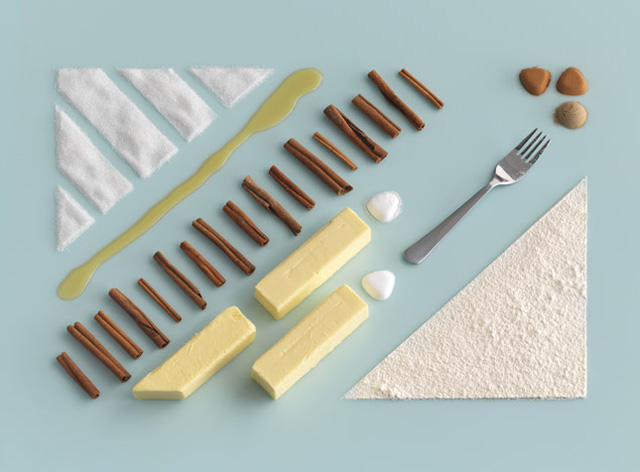
Has the age of the sloppy food photograph already passed us by? I think we might be in for a new wave of photos designed with more precision, less slop and here's why - I saw this on Hollister Hovey today:

And doesn't it remind you of this shot, which made the blog rounds a couple of months ago, courtesy of IKEA?


If the Hollister Hovey photo is a sign of things to come - and I think it is - I'll be happy. I've been over messy food porn pics since before Bon Appetit's covers started oozing. I'll take my food magazines photography carefully styled, thank you. I see enough messy food at home.

Wednesday, September 29, 2010

Artsy: IKEA Cooks

My friend Joyce just alerted me to this: IKEA has released a baking book, available only at its Swedish stores, called Hembakat är Bäst ("Homemade is Best"). The book is in Swedish and I don't really bake anyway, but I would love to get my hands on one just for the ingredients styling. Check it out:


Gorgeous, no? More pictures here and here...I could look at them all day.

Wednesday, June 30, 2010

Artsy Wednesday: Modern Food

Last week, Libby sent me a link to this:
Opens up a whole new world for an awesomely artsy and pretentious dinner party, no?

Friday, March 26, 2010

Why Don't I Care More about the Obesity/Art Study?

The study reads like something I'd be totally interested in: an analysis of portion sizes in 52 paintings of The Last Supper, conducted by a consumer behavior expert from Cornell and a minister who teaches at Virginia Wesleyan (who are also brothers). The findings are intriguing, indicating that portion size has grown, on canvas at least, over the last several centuries.

Art+food - it's got my hot buttons. And yet, it leaves me cold, and really only interested in my own lack of interest. In fact, I didn't even decide to blog about it until I read about the study in three other places. Is that because I just don't care about obesity? Or am I in denial because I like to eat? Does it matter?

Wednesday, March 17, 2010

Artsy Wednesday: Vik Muniz

How did I just find out about Vik Muniz? The Brazilian-born, Brooklyn-dwelling artist creates works of art out of food (like the Double Mona Lisa, After Warhol, which is made of peanut butter and jelly) - you'd think I'd have discovered him at some point before now!

But no - it took a feature in Food & Wine, with Daniel Boulud, no less, for me to find out about Muniz and his artsy-foodsy creations.

But now I know. And good for F&W for celebrating the foodie artist. I love it!

Friday, February 05, 2010

Artsy: Starry Starry Night Cake

Libby is all over the internet today. Look what else she found - a Van Gogh cake:
Maybe I should've pursued an artist theme for the Kit-and-Dixon SNOMG cake, instead of letting Dixon run with his "use every cake decoration in the pantry" approach. Look how proud he is: And this is what that cake looks like up close:

I'm pretty sure the sprinkles are thicker than the cake in one spot. It's lovely.

Wednesday, December 16, 2009

Artsy Wednesday: Tim Chumley Cross Sections

Yesterday, Cail sent me a link to these gorgeous cross-section photos by artist Tim Chumley. He photographs very thinly sliced pieces of fruit and vegetables, to great effect. More proof, of course, that food really is art.

Wednesday, September 30, 2009

Arty Wednesday: Art/Food in the Washington Post

Can food ever be elevated to the level of art? Even really great art?

Not a new question, right? Especially not here on this blog, where I've written about food and art more times than I can count. My take, very simply, is that yes, it can.

Blake Gopnik is not so sure. But Ferran Adria and Jose Andres are doing their damndest to convince him.

On the eve of the US publication of Adria's elBulli book, Food for Thought, Thought for Food, Gopnik, the Washington Post art critic, visits and eats with Adria at elBulli in Spain and with Andres at Minibar right in DC.

Gopnik eats a lot of crazy things that look like one thing but taste like another, or look like one thing and taste like that thing, but have a different texture, or look and feel like what they taste like, but are made in some unusual manner.

In addition to eating, Gopnik chats. He listens as Adria insists it's not about technique. But it's not exactly about the food itself, either - at least not how the food tastes. It's about what he wants to say with the food. The message.

He quotes Andres, who says, "We don't want to feed people, we only want to have a conversation."

Gopnik describes Adria' cuisine as, "a new language, yes, but without an identifiable homeland, and with the possibility that it will be radically reinvented at any moment. That instability makes it barely even count as a language."

None of this feels new to me, but I have been arguing with my family and friends about food and art and various related topics for a while now. The message-driven, not-quite-a-language status of this outsider cuisine reminds me, in a way, of conversations I've had with my dad about minimalism.

It's more than a little difficult to appreciate the minimalist movement unless you know a lot about the theory behind it and the history of all the art that came before. Yes, it's peaceful to look at a white canvas, but it's also easy to write it off as hackery. To enjoy it, you have to buy into the idea that theory's important when it comes to art (or food). My dad absolutely detests minimalim because he doesn't buy into the validity of theory-driven art. I have a feeling he'd do some scoffing at Adria's brand of cheffery, as well.

Ultimately, Gopnik enjoys his meals and his conversations. But he's not sold.

I, however, am not totally sold on his conclusion. I can't help but read it as art snobbery trumping food snobbery. Though he makes a blanket statement suggesting that, "of course food can be art," I'm not convinced that he's willing to open his mind to even consider food on the same plane as more traditional forms of art.

Finally, as a bit of an aside, the title makes the "palate/palette" joke that I'm sure I've used way too many times. And the video caption uses "Guernica" a shorthand, which I totally do, all the time. I can't figure out if Gopnik, his headline writer, and I are all kind of lazy, or if we're all smart, awesome writers. Until somebody tells me differently, I'm going with the latter. After all, why not?

Wednesday, August 05, 2009

Artsy Wednesday: Grocery Store Semiotics

A long, long time ago, I was peripherally involved in some semiotic analysis of pubs in North Dublin. That project was, as you might imagine, extremely cool (and kind of funny, since it also included a video diary portion, with participants taping themselves as they got ready to go out and again when they got home from the pub. Priceless.)

Even before the pub project, though, I was interested in how retail spaces - their layouts and graphic elements - influence the way we shop. So, apparently, is Steven Heller. Writing in the NYT, Heller praises Berkshires artist Erin Piester for her hand-drawn signage that frames the produce in Guido's Market in Great Barrington, Massachusetts.

The signs are pretty, but I wonder if they're as unique as Heller thinks they are. I have a vague impression of seeing similar signage someplace around here...Atwaters, maybe?

Wednesday, July 29, 2009

Artsy Wednesday: Mondrian Cake and Artsy Desserts at the SFMOMA

I owe a big thank you to Libby for sending me this article and this blog post on pastry chef Caitlin Williams Freeman's cool cakes. Freeman makes the desserts at the Blue Bottle Coffee Bar, in the sculpture garden of the San Francisco Museum of Modern Art, drawing inspiration from the exhibits at the museum and from other works of art.

The blog post includes desserts by a few other artsy pastry chefs - they're all pretty amazing.

As a fan of both Mondrian and dessert, and having tried (and failed) to mimic modern art via pastry, I have nothing but admiration for Freeman and her fellow pastry artists.

Well, admiration as well as a burning desire to visit the SFMOMA while wearing a YSL Mondrian dress. Too matchy? Yes. But also the kind of dorky thing I love.

Wednesday, July 22, 2009

Artsy: Food in the Arts Blog

I am, quite obviously, a big huge geek when it comes to anything that combines food, social history and art. Much to Cooper's chagrin, my basement walls are covered with a timeline charting major events in food, art and regular history from the start of civilization until today. My bookshelves are filled with books - both fiction and non - related to food and art and culture. My internet bookmarks include a category called "social history of food."

So imagine my great, great interest when I first clicked on Bill Moore's blog, Food in the Arts. Moore is a retired professor of art history and on his blog, he examines the literal inclusion of food in art, and what it means in the larger context of society.

Swoon. Seriously.

Moore's project, which he dubs "Artists at the Table," has been underway since 2003 and in that time he has collected around 1600 images of art that includes food. On the blog, they're categorized into 25 thematic chapters, and he does have possible plans to publish the content one day.

Friday, July 10, 2009

Artsy: The Futurists' Failure

Is it possible to write about Italy without writing about food?

Just out of college, fresh from my art history classes, I might have said yes. After all, it's not like every Italian work of art is food-centric. But after reading this Slate series by Kate Bolick, I'm not so sure.

The series starts traditionally enough, with a trip to Italy. Bolick and a small crew of intellectual/academic friends headed to Rome and Milan this past February to explore the world of the Futurists, 100 years after the publication of their not-actually-that-famous Manifesto.

But let me skip to the end. Several months after the trip, back in New York. Bolick and one of her co-travelers, artist Karen Azoulay threw a Futurist-inspired dinner party. The dinner sounds kind of insane, but totally cool in that way that theory-based dinners are cool. It's a natural product of studying the Futurists, anyway, since they're one of the few artistic movements (that I'm aware of) that published a cookbook.

The Futurists were really proto-Wylie Dufresnes, seeking to bring science into the kitchen and to change the way people think about food in general. They understood the powerful role food plays in our lives - Cookbook author and Futurist leader F.T. Marinetti wrote:


"A given taste of something can sum up an entire area of life, the history of an amorous passion or an entire voyage to the Far East."

Totally. Of course, Marinetti sought to destroy the food that would remind Italians of their heritage, just as he wanted to destroy museums and libraries and other institutions that house the past. He felt that escaping the past and forgetting it was the only way to embrace the future.

And maybe he was right, for Italy anyway. Not entirely, of course - technology hasn't completely avoided Italy. It's not like Italian teenagers aren't texting all over Rome, just like the kids in America and Sweden and Australia and everyplace else. But Italy's brand, for lack of a better term, is still rooted firmly in the past. The way, way, way past. And the food is a part of that.

In the article, it's not the dinner party scene that makes this painfully obvious - that's expected, and still feels pretty avant-garde, actually. No, it's the trip. The friends amble through Italy, dizzying themselves with technology-obsessed art and discussing the less appealing aspects of Italian Futurism (the fascism and misogyny).

And eating. They look longingly at spinach and ricotta tarts, even as they munch on pizza bianca and seek out pasta carbonara in the shadow of the Coliseum. The food they eat has been a part of Italian culture for centuries and it looks likely to stick around for centuries more.

The author is conscious of it, too, and one of her guests admits that if he was a teenager growing up among the classical ruins and Renaissance worship of Italy at the dawn of the 20th century, when the rest of the world was moving full steam ahead into the future, destroying the past might have seemed like the only way out.

To answer my initial question, no. I don't think it's possible to write about Italy without mentioning the food. Not to write well, anyway.

On the last page of the magazine, Bon Appetit runs a column called "Feedback," in which celebrities answer a handful of questions about their food preferences. They're always asked "of all the places you've traveled, where did you have the best food?" Invariably, they answer, "Italy."

It's a blessing to have that kind of reputation - to the outsider, anyway. But to a frustrated teenager yearning for something new, I can see why all that pasta, and everything it means, might feel more than a little stifling.

[Images: Graphic art by F.T. Marinetti; Cover of the Futurist Cookbook; Dynamism of a Soccer Player by Umberto Boccioni]

Wednesday, April 22, 2009

Artsy Wednesday: Laura Letinsky


We have a lot of parties. Not surprisingly, then, I spend a lot of Saturday and Sunday mornings wading cleaning up the remnants of the night before, wishing I'd thought to put the cheese away earlier and wondering how, exactly, 10 people managed to use 30 glasses.

Those mornings must be why I'm so drawn to Laura Letinsky's still life photographs of post-meal, post-party tables. They beautifully capture that feeling of post-party stillness and muted sadness, of drama passed. But they're pretty, too, with careful color and delicate detail.

Though not really right for my house (and out of my price range anyway), I love the idea of hanging a Letinsky photograph in a highly trafficked spot in an open kitchen. Perfect party centerpiece.

Wednesday, April 15, 2009

Artsy Wednesday: Cocktail Attire

In case you missed it...on Friday's "Entertaining" post, commenter TheSlapster left a link to an awesome set of Mad Men illustrations on Flickr. Created by an illustrator named Dyna Moe, they've been used everywhere from newspapers ("Mix It Up" to the left illustrated a Minneapolis Star-Tribune feature on show-era cocktails) to Rich Sommer's Christmas card to the cast.

The illustrator originally created the drawings as screen savers - one for each episode. She also - very nicely - encourages downloads for personal use. Though if you wanted to actually, you know, patronize, she's got several things for sale.

You know what I don't like, though? The reminder that Don Draper is nearly as old as my Uncle Jack.


LinkWithin

Related Posts with Thumbnails