Showing posts with label global cuisine. Show all posts

Thursday, June 01, 2017

Catching Up After Two (!) Months

Center Cut Doughnuts have brought me some joy over the past couple months
When I woke up this morning, one of my first thoughts was that it's been two months (yikes!) since the last time I posted. That's the longest stretch I've gone without posting since I started this blog back in 2005. Crazy.

In the past two months, I have been around food, though thanks to both the stomach flu and pneumonia, I actually haven't been eating with quite as much gusto as normal.

But still, there was a good dinner with old friends from California at Chez Billy Sud, a charming French spot in Georgetown. And a fun morning with my Dixon, my sister and her new baby at Sub Rosa, a really good bakery she can walk to from her house in Richmond. And The Emporiyum, which is always a great time. A tasting at Center Cut Doughnuts, when Dixon was my plus-one. A fun seafood boil over Memorial Day weekend up at Keuka Lake.

Plus, I haven't stopped writing for other publications. Though it's not all published yet, I've spent the spring thinking and writing about the opening of the Sagamore Spirit distillery, the food policy at Camden Yards, the origin of crushes, the city's best fried chicken, and iconic beach foods.

I've also continued to write my weekly restaurant news column, Hot Plate, for Baltimore Fishbowl. And do some Facebook and Instagram posting, of course - though even that has fallen off a bit, especially over the past month (pneumonia really sucks).

During that time, I've also started, but haven't finished, a few posts with actual substance - things like what makes a local classic actually classic and how to be a good restaurant guest. But - and I hate to say this - much of the larger conversation taking place around food these days frustrates me more than it inspires me.

When I started writing this blog, a dozen years ago, the food world was in a massive state of growth. Every day, something new and interesting was happening. There was debate about topics like authenticity and egregious experimentation and globalism; participating in those debates left me feeling invigorated and excited about what was to come. I assumed it would be better than what came before.

In recent years, though, two things have happened. One is that many of the smaller conversations have disappeared - though I'm seeing interesting chats on Facebook sometimes, much of today's food buzz takes place on Instagram, which doesn't exactly lend itself to thoughtful conversation (though it does lend itself to 20 media/influencer types posting pretty much the same photo).

The other phenomenon is that those debates - the ones about authenticity, experimentation and globalism - have evolved. Or, rather, devolved...and I am decidedly less excited about food as a result. The words "cultural appropriation" don't excite me. They frustrate me - at best. Mostly, they bore me.

People speaking against cultural appropriation are, theoretically, trying to promote respect for other cultures - which is all well and good and it's tough to argue with that point. Respect is great. Duh.

But the by-product of the movement is that it chills creativity and collaboration. And that chills my level of excitement about the food world as a whole.

Overall, I'm not easily offended and I like feeling enthusiastic. I want to be excited about food and drinks and I want to participate in conversations about what they mean to us - the role they play in our lives and our culture. That's what this blog used to be about.

But these days, I'm struggling to gin up any enthusiasm for the cultural conversation.

Fortunately, the pendulum is always swinging. Soon enough, we'll have moved on to a new topic within the food world - hopefully one that gets me more excited.

And until then, at least I have doughnuts.

Tuesday, July 14, 2015

Insta Data...on Food

Instagram's food data crunching and presentation is just on fire right now. They've created a cool, semi-interactive website focused on "The Food Capitals of Instagram" - the cities where certain frequently photographed foods are hottest.

Since the data is driven by numbers, it's not a huge surprise that large global cities - London, New York, Seoul, Sydney - dominate the discussion. But there are still some intriguing findings.

Like this: apparently right now, 7.5% of all photos of pulled pork originate in...London. That's a higher percentage than come from NYC, which is a whole lot closer to the heart of BBQ country.

That doesn't completely surprise me. After all, when we were in Paris last year, McDonald's was advertising the hell out of a southern sandwich, proving that southern cuisine really had overtaken the Western world.

It's a good lesson, too, in how trends expand and what is truly global. (The answer: pizza. Pizza is truly global.)

I wish the website allowed users to drill down - I'd love to be able to explore regional stats, especially in the US. Right now, you can get a general sense of what's happening and where, but nothing specific.

But still, it's cool. Data + food always makes me happy.

Monday, April 09, 2012

The Local-Global Pendulum Meets Southern Cuisine

A couple weeks ago, my whole family got together at my parents' house to celebrate my dad's birthday. We were talking about food (because what else do you talk about?) when the conversation descended into a  "Who's on first?" style mess. My sister-in-law asked me if I'd ever been to Charleston, commenting that after reading the recent Washington Post article about Woodberry Kitchen, she got the impression that WK is a lot like Husk.

I haven't been to Husk, or to Charleston, but I had read the article and, based on what I've heard about Husk, I told Cail I thought she was right. Then my mom chimed in with a confusing comment about a neighbor who doesn't really care for Charleston because she thinks the food is "too rich" and my brother expressed surprise that I'd never been to Charleston - but I was sure he knew I hadn't been there.

As it turns out, he did know I'd never visited Charleston - the city. Cail and I were talking about the Holy City, while my mom and brother were talking about Cindy Wolf's famously fancy and, yes, rich, restaurant here in Baltimore. (Though I haven't actually been there, either.)

All that talk about Charleston and Husk and low country flavors in Baltimore - topped off by a late-night viewing of Shag - got me thinking. These days, Southern cooking is on quite a pedestal. And Southern flavors are steeped in so much history that it's easy to forget that not so long ago, regional cooking - in the South or anyplace else - wasn't exactly front-page news.

Back in the early days of M&G, I wrote a handful of posts lamenting the demise of regional cuisine (most notably here and here). The first post I wrote was triggered by my sister's college graduation dinner at the Southern Inn in Lexington, Virginia...which, despite its name, was not very southern at all. The dinner was OK, but I was disappointed that it lacked any regional distinction. I could've eaten the same dinner in California, New York, or the Midwest.

I wasn't the only person concerned back then, either. A year after my post,  an essay by Salma Abdelnour called, "The Insidious Rise of Cosmo-Cuisine," appeared in the May 2007 issue of Food & Wine. Abdelnour observed that the best chefs of the day lacked a culinary connection to their hometowns, with menus borrowing from cities all over the world, but not necessarily from their own backyards. That essay got a lot of attention; it also appeared in Best Food Writing 2007.

At that time, eating locally was a hot topic - "locavore" was the OED word of the year for 2007 - but that was more about where to buy ingredients vs. flavor profiles. In those days, the most celebrated food in the world was coming out of Spain (specifically, out of Ferran Adria's head), but it wasn't lauded for its Spanishness so much as its edginess. Technique was king. Top Chef viewers were talking about Hung's knife skills and Blais' wild ideas and careful execution, but not nearly as much about how their backgrounds might have influenced their cooking choices. Local food was on the rise, from a logistical standpoint, but from a creative perspective, we were all thinking global.

And then something shifted.

Today, El Bulli is no more and the Top Chef judges have seen waves of regionally-focused cheftestants. The Southern Inn, which inspired my first post on the subject, touts fried chicken and country ham all over its menu. And Charleston's Husk, described on its own website as "a celebration of Southern ingredients," is widely considered the country's best restaurant.

What happened? Something natural and cyclical, I think - though I don't know that we're experiencing a resurgence of American regionalism so much as a burst of interest in Southern flavors in particular. Here on M&G, the first mention of Charleston - which seems to be at the heart of this Southern food revival - was in April of 2009, when I wrote about Elle Decor's profile of the city.

In July of that year, the Baltimore episode of No Reservations aired and one of the show's (few) bright spots was Bourdain's smart identification of Baltimore's southern culinary roots, on display via lake trout and pit beef.

In November 2009, I considered pimento cheese super trendy and the following month, I sang praises for Kevin Gillespie's mission to cook food that "has a sense of place" (that place being, of course, the South). A rise in Southern flavor profiles was one of my predictions for 2010. By May 2011, when Garden & Gun (which launched in April 2007) won the National Magazine Award, the Southern revival was so firmly in place on a national level, the magazine could launch a semi-regular blog all about finding the South in New York City.

A few days after my father's birthday dinner, Alicia gave me a magazine her parents picked up on a recent trip to Charleston (Alicia's dad, Big G, is a Citadel alum). The magazine, called The Local Palate, bills itself as covering "food culture of the South," though it's mostly about food in Charleston vs. the region as a whole. Either way, its mere existence goes to show that regionalism is alive and well, at least in certain pockets of the country. The cover refers to "The Second Coming of Southern Cuisine" and on the inside, one of the most intriguing pieces, "Southern Revival" by architectural historian W. Barksdale Maynard, carries the lofty subtitle, "Living in the Golden Age of Southern Cuisine."

I can't find the article anywhere online (the rest of the issue is here) and that's really a shame because Maynard does an excellent job tracking the peaks and valleys of popularity experienced by Southern cuisine. His conclusion is that, "the long decline is over: traditional Dixie cuisine is back," and he quotes revered Southern food historian/champion John T. Edge, poo-pooing those who fret that the South has grown less "Southern" thanks to homogenization and Northern migration. Edge insists, "That concern is cyclical and maybe even permanent, this notion that Southern food is in peril." In other words, every generation worries, but the world keeps on spinning.

I suppose I should take those words to heart, too. After all, it was only five or six years ago that I was dramatically mourning regional cooking. And look where we are now: regional cooking, in the South at least, has risen again.

Wednesday, February 10, 2010

Bourdain: Turns Out, I'm Still Bitter

Mmm...blue crabs. Nuclear blue crabs from the Hudson.

Last night, as we wrapped up the newest episode of No Reservations, in which Tony travels up the Hudson River, I realized something: I am not going to get over Bourdain's shabby treatment of Baltimore. It's permanently colored the way I watch his show.

Apparently Bourdain doesn't care what people in Baltimore think of him, anyway. Last night, while picking crabs with a couple of old-timers from a Hudson River town that's inconveniently nestled next to a nuclear power plant, he took the opportunity to mention that the crabs were better than anything in Baltimore and that they should be anyway, since New York is, of course, better than Maryland.

You know, I like New York and I like a lot of New Yorkers. But that attitude? Annoying and unjustified.

Plus, the crabs were totally underseasoned. And Bourdain didn't even really know how to pick them, even though he used to live here.

My issues with the episode didn't start and stop with the Bmore references, either. While I like Michael Ruhlman and everything looked pretty, I wasn't that impressed with the food.

I'm sure the food served in CIA instructor Chef Pardus' backyard tasted good, but I was sort of put off by watching a bunch of displaced Manhattanites eating banh mi - and I was definitely put off by Pardus' 10-going-on-40 daughter, who apparently has never heard the words, "Don't use that tone of voice." I'm sure she's a smart little girl, but, um, a tad insufferable? I got the impression that every adult in her presence has praised her for being adorable and funny. To me, though, precocious does not equal adorable.

(Now I feel mean for criticizing a 10 year old, especially when it's really her parents' fault.)

The final scene got to me, too. Bourdain had dinner with Bill Murray, who I love, at a restaurant near New Paltz. Walking into the restaurant, Bourdain mentioned that as a general rule, the quality of the food at a restaurant is inversely proportional to the quality of the view. I agree - and considering how much time I've spent eating out in Annapolis, I know what I'm talking about.

Bourdain insisted that the food at this restaurant defied that rule. I'm sure it did. But it still wasn't interesting enough to warrant a spot on the show. No groundbreaking creativity, no unique local flavors - just your standard fare upscale cuisine (which I started complaining about back in 2006). It looked to me like the real draw of the restaurant was that the owner's friends with Bill Murray. I get that he's a big star and everything, but isn't No Reservations supposed to be above that sort of thing?

The show did have some bright spots, though. The salty dog marina bar looked great, the sausage-making guy was inspiring, and I loved the sailing scenes. In fact, I think somebody on the Severn needs to get on that floating food cart thing. (Anchor in between the bridges - you'd be out of the way and you'd get traffic from all parts of the river.)

Overall, though, the episode disappointed me in tiny ways along the way and it didn't hang together as a whole - the overriding theme was weak. The Hudson River might be a beautiful, fantastic place to eat. But that show didn't really sell it to this Maryland girl.

[Photo credit: Travel Channel]

Monday, April 06, 2009

Trendy Monday: Places to Watch

The May Food & Wine arrived the other day and, with it, a "go list" - the world's best food cities plus 20 "rising star" restaurants in the food world. For anybody paying close attention to global food trends, there aren't a ton of surprises, but it's interesting reading anyway.

The "best" food cities are mostly what you'd expect: Tokyo, Barcelona, New York, London and Copenhagen. The most interesting inclusion on that list is Copenhagen, which the magazine calls an "avant-garde stronghold." That's very F&W of them. I'm trying to imagine what #5 would be on, say, Bon Appetit's list. Something in Italy, maybe? Shanghai?

The rising star restaurant list provides a little more geographic diversity, with spots in Hong Kon, Lima, Dublin, Buenos Aires and Melbourne. Oddly enough, Momofuku Ko is included on that list. I guess I have a hard time thinking of a restaurant that's gotten that much ink as a "rising star."

But that also might just be because I read a lot about newish restaurants?

(As an aside, this is my 800th post on M&G. I've been writing for just over 3 1/2 years and writing every weekday (minus a couple of days last fall when I was in the Bahamas) for almost a year and a half. Wordy, huh?)

Wednesday, August 20, 2008

Artsy Wednesday: Enric Rovira Chocolate

Yesterday, Cooper and I watched Monday night's Bourdain, in which our hero visits Spain. What an amazing episode. This whole season's been pretty stellar - I'd be hard pressed to pick a favorite - but this was a real foodies' espisode. At the start, Bourdain even mentions that food bloggers are going to freak out over this trip.

And I did.

The whole show was pretty intense, and between Cooper and I, we'd read more than a little about pretty much every single chef featured. I very nearly got online to order some of the canned seafood Bourdain tried at the Espinaler Bodega...until I realized it was going to cost about $300 a can (I'll stick with my beloved grocery store smoked oysters, thanks). Honestly, the care, skill and creativity demonstrated by the chefs actually caused my eyes to well up a little bit. Everything was just so impressive.

Overall, the show was a great illustration of how old and new layer together, and how tradition and innovation and technology and intuition can come together to create something amazing. Sometimes the time and place and circumstances are just right, and everything adds up to much more than the sum of the parts. That's the Spain I saw in this episode.

I could write for days about each of the places Bourdain visited, but since it's Wednesday, and Wednesday is "artsy", I'll keep it simple. The picture below (snagged from the Travel Channel website) is a chocolate egg created by Enric Rovira. Each egg is painstakingly molded, then slightly melted by the sun until a small hole forms. At that point, the egg is rushed inside to set, then airbrushed with a combination of chocolate and cocoa butter to create a matte finish.

Talking about the chocolate, Bourdain referenced the undulating, naturalist, art nouveau architecture of Gaudi, and I totally see that. I was actually also reminded of certain Brancusi sculptures. All around, the chocolate sculptures were amazing and I would totally buy one, if only they were available in the US.

This is before the hole has completely broken through and the final finish has been sprayed on. The end result is slightly lighter in color, and not nearly as shiny - with a hole where the indentation is.

The combination of the exact construction of the initial egg and the totally organic, traditional element of the sun melting the chocolate create a final product that evokes the larger story of what's happening in Spanish cuisine today.

Bourdain was right. This food blogger, at least, is freaking out about this episode.

Friday, May 09, 2008

Regionalism: The Map

If you are at all interested in regional foods, the shifts and trends that change consumption and culture, or really cool maps, click right here, right now.

To accompany a review of the book Renewing America's Food Traditions by Gary Paul Nabhan, the New York Times created an interactive map of the US (with a bit of Canada and Mexico thrown in). The country is divided into regions defined by their cuisine, with mouseovers for each area explaining what foods native to the region are in danger of one day disappearing.

No big surprise, I live in Crabcake Nation (though what is a bit of a surprise is that Delaware, which is culturally so like Maryland, is in Clambake Nation).

I found this via Mr. Henry, who reminisces about the different foods he's had that might one day be gone. Sort of sadly, I couldn't really do the same, since the only food on any of the lists that I'm absolutely positive I've eaten is...you guessed it...Chesapeake Bay blue crab.

This so perfectly ties into all of my concerns about the globalization of cuisine and the simultaneous disappearance of regional flavors and dishes.

Even though, as I just mentioned, I've got a mile-high stack of books to read, I just might have to actually buy this one. It just hits too close to home.

Monday, March 10, 2008

Trendy Monday: Irish Food Everywhere

It's the week before St. Patrick's Day, so my email inbox is filled with "great Irish recipes for the holiday".

Right.

I haven't been to Ireland myself, though by all accounts the cuisine has improved a bit over the past 10ish years - I guess maybe that's one good thing that's emerged from the globalization of cuisine. But on the whole, as I understand it, the food of the Irish is still pretty bad.

My own personal experience - I am nearly all Irish by ancestry - is that corned beef and cabbage smells bad and sort of tastes like it smells. I forget where I read it, but just recently I saw a quote something like this: "Never choose to eat the cuisine of a country known for its famine."

Somehow that seems about right.

And yet the emails persist. As for me, I started celebrating early yesterday at Ryan's Daughter with fish and chips (the only thing they really do well, in my experience). And we will celebrate next weekend at home...without any Irish food at all. Well, maybe a potato or two. But they will NOT be the main event.

Anyway, we all know what the Irish really do right. Drink. THAT is a holiday trend I can support.

Friday, March 07, 2008

But What Do YOU Want to See Before You Die?

I'm finding this Althouse post and its comments sort of mesmerizing. As a general rule, I enjoy glancing through books like 1,000 Places to See Before You Die. Obviously, I'll never see all those places, but I never would've heard of some of them, either, if not for the book.

Althouse links to an article about the publishing trend toward these types of books, and mentions the oft-forgotten second half of the title: "Before You Die". The half I tend to ignore when I'm flipping through the pages.

In the comments, the discussion turns to the many ways it's possible to fully experience life without visiting your travel agent, book in hand. Several commenters get spiritual in a sort of "eastern" way, basically saying that life is an internal journey, not necessarily a global one. That people who sit still and reflect will learn more than those who jetset without stopping. They're not suggesting that travel is bad, but that blindly following a book's checklist without thought is not exactly the path to enlightenment.

In the middle of the comments, Althouse chimes in with a suggestion:
Maybe everyone should a list of 1000 things that you've found worth seeing within 20 miles of your home. And it's not a list for other people to do and check off. It's an exercise to teach yourself that you are completely in the fascinating world wherever you happen to be. (Excluding some disastrous places.)

Regular commenter Pogo starts listing right away with a couple of powerful (in the emotional way, not, like, the political way) people and places within a block or two of his house. Another regular commenter, Beth, who lives in New Orleans, relates this idea to her post-Katrina experience, watching well-loved institutions immediately or gradually disappear from her life. Both offer a pretty meaningful lesson in appreciation and not taking things for granted.

Obviously, this is about something bigger than food. But food has to be a part of it. For one thing, my list of 1,000 places to see about my home would certainly involve the inside of a lot of restaurants. Not necessarily the Petit Louises (what is the plural of Louis?) either. My list would say things like "See the deck of Carroll's Creek Cafe from a table with a bowl of cream of crab soup in front of you. Preferably on a Wednesday night so you can watch the races. Do this in May or June of 1996."

Beyond my own personal experiences, these days, you can't separate food from travel. It's everywhere you look. Between Bourdain and Zimmern and Samantha Brown and, well, everybody else on the Travel Channel, food and travel are increasingly tied together in the public mind - not just the minds of foodies who have been searching for the most "authentic" of whatever for a handful of years. It can't be long before we see a book called "1,000 Things to Eat Before You Die".

And these are those forces that drive me crazy - the ones that have led to "the insidious rise of cosmo-cuisine", to steal the Abdelnour title. I won't go off on my rant again, though. I've already said enough on that subject.

Finally, because this post is feeling a little heavy (and long) to me...here's the "Stuff White People Like" take on it. It's funny. Because it's true.

Thursday, January 31, 2008

Old School Thursday: Pop Foods & Globalization

Happy National Brandy Alexander Day! Do people even drink things like that anymore? I know that a few years ago, there was a resurgence of classic cocktails…but it didn’t extend to my house.

Speaking of classic, today has a few dogs in the “global products” fight. (Maybe I should’ve waited until today to write my “OK just go global” post.)

Today in 1893, the Coca-Cola trademark was recorded. Nearly 90 years later, in 1980, Coke began substituting high fructose corn syrup instead for half the (more expensive) sugar in their products – at least their products sold in the US. I’m not sure how controversial the switch was at the time, but I do know that there are some soft drink experts who believe that a switch back to sugar would be a smart move these days.

In other global junk food news, today in 1990, the first McDonald’s opened in Moscow. I won’t go on and on about it, but events like this played an important role in my decisions to major in international relations, minor in art history and eventually get into advertising. Behold the regime-shifting power of global brands and all that. I am painfully theoretical sometimes.

And on a totally different note, today in 1948, the New Yorker published J.D. Salinger’s essay “A Perfect Day for Banana Fish” – eventually the first essay in Nine Stories, a book that I was (predictably) obsessed with around ninth grade. Dixon is probably lucky he’s not named Seymour.

Wednesday, January 30, 2008

Artsy Wednesday: Forget Local, Let's Go Global?

Local, local, local. We're hearing a lot about it, right?

And rightly so. Local ingredients are great for local economies, they're good for the environment, they're often cheaper than alternatives, and most importantly to me, they taste really good. But there's something that's bothered me about the prevalence of the "local" argument: somehow it's coexisting with the demise of regional cuisine (that I've written about before here, and that was summarized elegantly and excellently by Salma Abdelnour here).

How is this possible? Why can't we glorify local flavors along with local ingredients? Are chefs who don't live in highly esteemed food towns afraid to really celebrate their locations?

As I've said before, it's not that I completely dislike global cuisine. I majored in international relations! I love globalism! Bring on the fusion, I say. Just not everywhere.

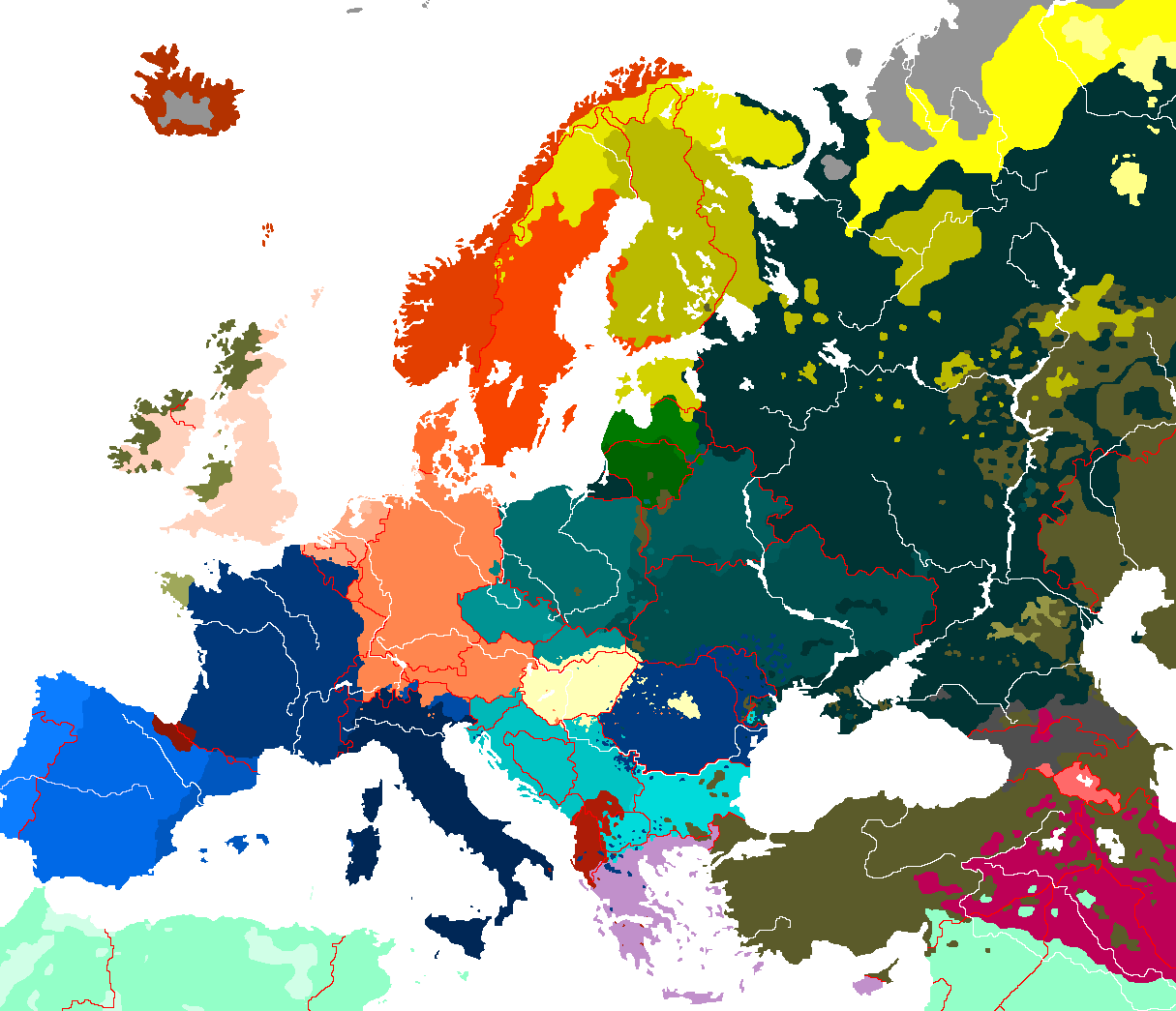
But in the spirit of embracing the way things are, instead of just lamenting how I wish they were, I give you two cool, artsy, interesting maps of the world. The first (courtesy of my brother) is a map of the languages of Europe. The diversity is not exactly surprising, but a good reminder, nonetheless. I would, actually, like to cross this map with a visual showing different regional dishes. Or maybe even just one dish, but the different names it has - like salt cod cakes.

The other map is a little more entertaining - it's from The Onion. Just full of fun facts that are true, but also gently mock the countries they reference. This week, the featured country is "Colombia: South America's Middleman". Makes me laugh.

Sunday, April 22, 2007

Back to the Regional Thing

In the May issue of Food & Wine, F&W travel editor Salma Abdelnour writes the article I would have written, if only I had a gigantic travel budget.

I went on a mini-tirade about the rise of a class of fancyish cuisine overpowering regional cuisine of a certain level. Street food will probably always reflect its birthplace, but five-star (even three-star) restaurants have increasingly adopted an uber-fusion approach.

Since I wrote those posts last summer, I've noticed the phenomenon over and over again. Even as I watch Paula Deen's sons, Anthony Bourdain, and about a zillion other travely chefs set out to find the foods that quintessentially define everyplace from Birmingham, Alabama to Mumbai, right here in my own backyard, classic Maryland food (straight up crab cakes, oysters, rockfish) is increasingly schmancied up to meet some sort of vague international standard.

And this is exactly the topic Abdelnour tackles. Her job has taken her all over the world, from home kitchens in Morocco to five-stars in Paris. She's got a solid basis for her argument, which she labels "The Insidious Rise of Cosmo-Cuisine".

Which both pleases and disappoints me at the same time. Because while I'm thrilled to see my exact thoughts validated in my favorite magazine ten months after my initial post, I can't be anything but slightly dismayed that this epidemic really is occuring on a global scale.

But, I guess, at least we'll always have the cheap local stuff. At least, that is, until street vendors start cranking out emulsions and reductions.

And when that day comes, well, God help us all. Especially the line cooks.

LinkWithin

Related Posts with Thumbnails