Thursday, January 24, 2013
In the Mail: Food Lovers' Guide to Baltimore
Obviously, I'd find a book like this interesting, but in this case, I was more thrilled than usual to crack it open...because it's written by Kathy "the Minx" Patterson and her husband Neal.
I'm a fan of Kathy and Neal's writing - they're funny and have a light touch that's welcome. Sometimes food and restaurant writing takes itself so seriously.
The book itself is super useful. Not only did Kathy and Neal hit pretty much every restaurant of note in the area, they also cover wineries and breweries, festivals and food-related events, local shops and farmers markets, and food trucks. AND they had local chefs contribute a handful of favorite recipes.
Oh - and they mention blogs and websites, too. Of course.
Not that their (very kind) words about M&G are influencing my recommendation. Actually, they're really not (though I appreciate the mention). Even if they'd ignored M&G entirely, I'd suggest buying the book. You'll never struggle to find a restaurant again.
Monday, June 13, 2011
Recently Learned Chez Pollard
Wednesday, June 09, 2010
My New Favorite Author: Marne Davis Kellogg

A few weeks ago, as I wandered through the library stacks in search of a new book to read, I came across an author I'd never heard of: Marne Davis Kellogg. The two books at my branch of the library, Perfect and Friends in High Places, had promise. Their cover art was pretty in a sort of retro, Art Deco way, the books were set in England, Provence, the Amalfi Coast, and the Alps, and - best of all - they were about a super-smart international jewel thief named Kick Keswick. Sign me up!
Once I got into the first book, I realized I didn't just like it, I loved it. Kick a strong and interesting character, the settings are fabulous, and even though I'm not really that into jewelry, the descriptions of the jewels (and the fake jewel fabrication process) is pretty captivating. But that's not all - there's also the food. Take this passage (from Brilliant, an early Kick Keswick book):
"Do you want something for dessert?" I asked, after taking him on a quick tour. "I have some fresh apples. I could make a Tarte Tatin."
"I can't think of anything I'dlike more. I saw a bottle of '71 Chateau d'Yquem in your cellar. It'll go perfectly."
Of course. He knew without my having to tell him.
I peeled and sliced the apples and put them on to simmer in a cast-iron skillet with a huge amount of butter and sugar. While they caramelized, I went to work rolling out the pastry. Thomas poured us each a small glass of the exquisite dessert whie, which filled our mouths with the bouquets of rich, sweet fruit.
All of that took place in Kick's Provence farmhouse kitchen. Sigh.
Kellogg has an earlier series of books, too, about a lady Marshal named Lilly Bennett, who lives in a fancy, Jackson Hole-type town in Wyoming. She's just as strong a character as Kick, and they share a classic, understated brand of glamour that I find really appealing.
Don't get me wrong - these aren't deep, philosophical books. But they are great stories with strong characters and a fabulous sense of place. Just about the best beach reading I can imagine. Plus, the food. There is so much great food.
Wednesday, March 18, 2009
Artsy Wednesday (also Book Review): The Billionaire's Vinegar by Benjamin Wallace
The rest of the book zigzags between years, explaining the evolution of the wine market, the nearly-untouchable world of high-end, rare wine tastings, and the investigations and doubt surrounding the Jefferson bottles and the man who "discovered" them, German music producer-turned-collector, Hardy Rodenstock.
It's pretty amazing.
While it's clearly a history book, and the Tarantino-like chronology is a little confusing at times, TBV is a good read. Wallace is a compelling writer and, obviously, a pretty fantastic interviewer. He got cooperation from pretty much every major player in the rare and old wine world, and got them to say some stuff that's revealing. What's interesting, too, and that I didn't realize until I was nearing the end of the book, is that the whole Jefferson bottle affair wasn't 100% settled when he decided to write the book. His research ran in parallel to several other investigations and appears that the book itself contributes to the overall case. Cool.
So the book would be worth reading even if it was fiction. But it's not, and I'm also fascinated by what I learned about the wine industry - especially in the US. My parents have always drank wine with dinner. My grandparents drank cocktails, but my parents always drank wine, so I've always thought of wine as a normal part of a meal.
What I didn't realize was that my house was ahead of the curve. If Wallace's story is to be believed - and I think it is - wine wasn't mainstream in America until fairly recently. Really great wine glasses weren't even available in the US until the late 1980's - which is crazy when you consider that Reidel glasses are now available at Target. The article jibes with Robert Parker's look at the last 30 years in US wine history that ran in Food & Wine last September. So I guess I shouldn't be surprised, but it still shocks me to read about wine and realize that I've been an active part of the awakening of the wine industry in the US (the later part of the awakening, of course, but part of it nonetheless).
But I digress. The Billionaire's Vinegar: if you're into wine, or drama, or history or forgery (according to Amazon, 13% of people who viewed the TBV page ended up buying The Man Who Made Vermeers, another book I really liked, even though it had nothing to do with food)...read it.
Tuesday, December 30, 2008
Quotable Tuesday: Alinea
It wasn't until I got to The French Laundry that I recognized food as it could be in an artistic way, in an individual expressionist way, and then it really caught fire. Once I got a taste of that, and what it did to me personally, how satisfying it was to come up with a new dish, that became my style, that became what was most important to me, constant creating. - Grant Achatz
If there's one thing I've learned from writing this blog it's that I believe food - and everything else, really - is at it's best when it exists somewhere in that vague space between art and science. It's there naturally, really, since the process of cooking is chemistry but the act of cooking is creative. But some chefs (both home and professional) seem to search harder than others for the discipline's golden mean.
Grant Achatz is, obviously, one of those chefs.
My brother got me the Alinea cookbook for Christmas. It's so intense. The photography is beautiful and the recipes are challenging. Maybe not in their individual steps, but in that they have so many steps, and that most of them require some sort of ingredient that you can't readily pick up at the Giant (not my Giant anyway).
But in it's intensity, the book inspires and, if nothing else, I love the essays at it's start.
Overall, it's a breathtaking read and one I'd recommend for anybody who loves to cook, or who simply likes to think about cooking.
Wednesday, August 13, 2008
Artsy Wednesday (and Book Review): Waiter Rant
It's been a long time since I've read a book cover to cover the day I bought it. But yesterday I did just that. Last week, Cooper asked me to buy him Waiter Rant, the memoir written by "the waiter", aka Steve Dublanica, the man behind the Waiter Rant blog.I've read the blog on and off over the past few years - Dublanica's writing is really accessible and of course the subject interests me. So I assumed I'd like the book, even if the transition from blog to book wasn't so smooth.
But it was. The transition was perfect. The book doesn't feel at all like cobbled together posts pulled straight off the blog. Not at all. It has a solid narrative structure with a fair amount of protagonist introspection and growth...plus a lot of funny customer stories.
I read the first 40 pages while sitting in Barnes & Noble, watching Dixon play with the Thomas trains, and the next 130 during the afternoon before Cooper came home from work. I was fully prepared to hand the book over to him (he's the one who asked for it, after all) but he selflessly told me to finish it first. So I did.
I really can't recommend it enough - as I said, the writing is great, it's funny and it's also sort of touching in that personal growth-memoir kind of way.
Also, if you're anything like me, you might have a personal growth experience of your own while reading. At first, I was a little freaked out, wondering if I'm a bad customer. Then I realized that no, I'm not a bad customer at all. And I plan to stay that way.
Tuesday, July 29, 2008
Whipped & Beaten: The Book
Sarah's a pretty funny girl, so I'm not at all surprised she's acquainted with somebody who's website includes apron-only pictures and recipes like Trailer Park Chicken Marsala. These are the kinds of things that make me laugh, anyway.
Oh, and the recipes look like they'd good, too.
Friday, May 09, 2008
In the Queue
There's this one about grilled pizzas, which I've read and I really liked and thought was very approachable - but I haven't had time to actually make anything from it. And one on Spain (that I can't find on Amazon) with beautiful pictures and mostly simple recipes but, again, I don't want to write the review until I actually cook something from it (I may wait for our figs to do that - they're little tiny green buds right now but in a few weeks, we should be up to our ears in them).
Just last week I got this in the mail, by the former head chef at Google. My first thought was, "it's the cooking Cluetrain!" - mostly based on the graphic design. I've barely had time to lift the cover.
And just yesterday, this book arrived. I'm especially excited about this one - who doesn't love reading about meat? - and Cooper's immediate reaction was to say, "I'm pretty sure I'm reading this one, too."
But as the pile grows, it's getting intimidating! Hopefully I'll be able to focus on a couple of these this weekend. It's a good problem to have - too many books about food.
Plus, on top of the books, I've had an honest-to-God essay stewing for a couple of months now. Something about art and religion and food and upper class tendencies. My meat and potatoes.
So soon, hopefully, really...I'll be back to writing a lot more.
Tuesday, April 29, 2008
Book Review & Preview: Comfort Food by Kate Jacobs
This personality trait - and I do think of it as a trait, rather than a preference - is totally, embarassingly reflected in the piles of books sitting on my bedside table. A handful of respectable food lit is interspersed with stacks and stacks of mindless trash (with really strong characters, if I may defend myself).
But you know what's not there? Chick lit. Oh, you'll find a few prominent chick-ish titles in my bookshelves, but not a whole lot. And the books that are in my house are mostly ones that either someone handed me and I never opened, or I bought in a moment of beachy weakness, but that I never read past page 50. For all my love of the trashily written word, there's something about that genre that just doesn't click with me. And I am not afraid to stop at page 50, skip to the end, read the last chapter, and then put the book away.
So it was with a bit of trepidation that I opened my fresh-off-the-presses advance copy of Comfort Food. It's written by Kate Jacobs, who also wrote the wildly popular The Friday Night Knitting Club - one of those books I'd heard of, but I never read.
To be honest, I expected to be bored by the book, and I expected it to set it aside after a few chapters. It's not the subject matter - the story follows a food TV star who sounds much like a thinner, New York-based Paula Deen, as she embarks on a new program and deals with changes at her network (and attempts to accept turning 50). It's interesting and plausible, but it has the potential to slide into standard fare drivel, if not handled correctly.
Fortunately, for me, my preconceived notions couldn't have been more off base. In fact, not only did I not toss the book aside after a few pages, I read it all in one sitting. I started it around 9 pm and finally turned out the light close to 2. It's that entertaining. Kate Jacobs is a good writer. The characters are well-developed and likable, the story is believable and taps into the current celebrity chef fascination (and discussions about the intelligence of the Food Network's recent programming decisions), and overall, it's a good read.
Is it philosophically challenging? No. Will someone who's already into food learn anything dramatically new? Probably not. But it is certainly entertaining, and if you're looking for a reason to stay up late reading, you should definitely check it out.
Tuesday, April 08, 2008
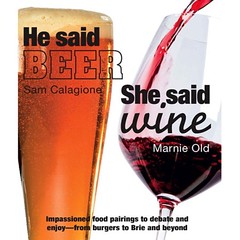
Book Review: He Said Beer, She Said Wine
It absolutely pains me that I'm just getting around to writing about this book, mostly because I read it immediately upon receipt. A month ago. There's just no excuse for it, except for me to say (once again) that I'm slack.
Now that I've gotten my self-flagellation out of the way...on to the book. It's pretty great. While I didn't actually sit down and read it cover to cover, I did glance through every single page - and so did Cooper. And he doesn't really do that.
The premise is pretty simple, and to make matters easy, here's the press copy:
Dogfish Head brewery founder Sam Calagione and renowned sommelier Marnie Old cut through the many misconceptions and caveats that come along with making great food and beverage pairings. Sam and Marnie frame the great drink debate, making a case for their beverage of choice, and the result is a fun, educational and revealing look at how what we drink can bring out the best in our food.
PR copy or no, that does actually sum up the book. What could be pretty dry and boring ends up personality-driven and a fun read - the authors' voices come through loud and clear and there are a ton of pictures of beer, wine, and food - and also of the authors, which I think really adds to the book's easy tone.
So there's a lot of general informational stuff - the types of wine and beer, what to expect, how to read labels, etc. I was already familiar with most of that, but that's only because of excessive drink-reading and tv-watching. And anyway, it wasn't a bad refresher.
I was primarily interested in the actual wine and beer pairing suggestions. They're very specific, and come complete with pictures of the bottles they suggest. The recipes included are pretty simple, and I like that they spell out with great detail how, exactly, you can set up a wine vs. beer tasting party at your house. See, Old and Calagione have hosted their own tasting parties in a few spots (including Calagione's Rehoboth Beach restaurant, which I've never been to, but now would like to go). So they know from what they speak.
I wasn't really up for hosting a full-on party as a part of my review, but I did want to test out their recommendations. Fortunately, my dad's birthday was the last weekend in March, and my whole family was coming up to my house for celebratory drinks, hors d'oeuvres and cake. Since I had a captive audience, I decided to make them work for their dinner.
I was already making scallops (that's the only thing my dad asked for), so I decided to stick with seafood and make Old and Calagione's mussels in a spicy red sauce. Despite never having cooked mussels at home before, everything went super smoothly. The sauce was outrageously easy and it totally delivered the spice (but not too much).
I had absolutely no problems finding the recommended beer (Birra Moretti La Rosa, a reddish brown Italian lager) at Wells, even though I'd never heard of it before (but then again, I'm not that big of a beer drinker). Unfortunately, the first wine store I went to (Beltway) didn't have the recommended wine (Banti Centine Toscana Rossa, a Sangiovese blend from Tuscany that's similar to a "plumper, juicier Chianti), and since that's a gigantic store, I gave up easy and found something that sounded similar in terms of taste (and promptly forgot to write down its name).
As a result, it's hard for me to say whether the beer's near-unanimous win over the wine was a result of my decision or the book's recommendation. My mom was the only person who preferred the wine, and even she said it was only because she really likes wine better than beer.
Neither match was a bad one, but the beer was spot on. In fact, even though I don't really like reddish brown beers, I truly enjoyed this one thanks to the match with the sauce. I wasn't the only one to feel that way, either.
But I digress. The short version of this post is: new book about wine and beer. I liked it. It's a great reference and is also a good read.
And also, mussels in spicy red sauce. Delicious.
Thursday, April 03, 2008
Book Review: The Sweet Melissa Baking Book
I am the worst kind of slacker. About a month ago, the Penguin Group sent me a copy of the Sweet Melissa Baking Book and I just, this week, finally baked something from it! I sat down and read it pretty much immediately (well, skimmed it) but I didn't want to write about it until I'd actually made something.
And I'm glad I did. Because gingerbread is delicious, and it's even better when it's got Guinness in it.
The book itself is nice - tons of recipes that I will make, even though I'm not much of a baker. Everything appears approachable, from old standards like snickerdoodles to more original (and very appealing) things like sweet potato bread with connamon-rum-orange glaze. I don't think there's much I could really mess up - the recipes are clearly written and they're not terribly intimidating, even to me, and I wince at the sight of a measuring cup.
The author, Melissa Murphy, owns Sweet Melissa Patisseries in Brooklyn, though from her picture on the back cover, it's sort of hard to imagine that she really eats much of what she bakes - she's tiny. It's also kind of hard to imagine that she won't be on the Food Network soon enough, she's too cute not to be.
She starts out each section of the book with a personal note, then prefaces every recipe with a little blurb about the recipe - something from when she was a kid or when she created the recipe or something like that. I'm such a fan of backstory - the blurbs alone make the book for me.
My only real criticism of the book is that there really aren't very many pictures. There are a handful, but just not a ton. The pictures that are included are shot in a style that I can only describe as "bloggerish" - extreme close-ups, out of focus backgrounds, sort of hazy lighting. They're nice pictures, but somehow not exactly what I expected. Maybe they're just not what I'm used to seeing in a cookbook.
Overall, though, it's a really nice book and one that I'll definitely use.
Here's the gingerbread recipe that I made (all copyright Melissa Murphy, of course). I should note - it doesn't taste super Guinnessy, but there are notes of stout in the flavor. It's dark. I liked it. As Murphy recommends, I served the gingerbread warm and with homemade whipped cream. It kind of needs the cream to balance it out (especially since mine ended up a little dry, as I continually underestimate the power of my oven).
But I would definitely recommend...both the gingerbread and the book itself...
"Gingerbread! I grew up making it for my Dad, it was one of his favorites at teatime on Sunday evenings. I'd whip cream with vanilla and just a little bit of sugar till it just held itself up, then serve a dollop of cream on top of the still-warm gingerbread. It would just start to get melty by the time we took our first bites.
"Truthfully, back then the gingerbread was from abox, though it really was very good! My Guinness Gingerbread is a bit more sophisticated, with dark chocaty stout, rich cocoa powder, and lots of spices - even a bit of hot white pepper."
2/3 cup Guinness stout
2 cups all-purpose flour
2 tbs best-quality unsweetened Dutch-process cocoa powder
1 1/4 tsp baking soda
2 1/4 tsp ground ginger
1/4 tsp freshly ground white pepper
1 tsp ground cinnamon
2 large eggs
1/2 cup granulated sugar
1/3 cup firmly packed dark brown sugar
2/3 cup molasses
3/4 cup vegetable or canola oil
BEFORE YOU START
Position a rack in the center of your oven. Preheat the oven to 350 degrees F. Lightly butter and flour a 9x9x2 inch square cake pan.
1. In a medium saucepan, bring the beer to a simmer and remove from the heat.
2. Sift together the flour, cocoa powder, baking soda, ginger, white pepper and cinnamon into a medium bowl.
In a large bowl, whisk the eggs, granulated sugar, brown sugar, and molasses until smooth. Whisk in the oil to combine. Whisk in the dry ingredients in three batches, alternating with the beer. (Dry, beer, dry, beer, dry.) Mix until just combined. Do not overmix.
4. Pour the batter into the prepared cake pan. Bake for 50 or 60 minutes, or until a wooden skewer inserted in to the center comes out clean. Remove to a wire rack to cool.
The gingerbread is best when served warm from the pan with freshly whipped cream. It keeps well wrapped in plastic wrap at room temperature for up to 3 days or refrigerated for up to 1 week.
(The foregoing is excerpted from The Sweet Melissa Baking Book by Melissa Murphy. All rights reserved. Copyright © Melissa Murphy, 2008.)
Monday, March 31, 2008
Trendy Monday: Still a Culture of Lifestyle
As I mentioned last week, Kamp addresses the rise of the concept of "lifestyle" in the mid-seventies. Towards the end of the book, he brings the subject up again, noting a resurgence in "lifestyle" as an important entity (of course I can't find the exact quote this morning). It was interesting to me to read about a "resurgence" - since I didn't realize that "lifestyle" ever left, at least as a marketing tool.
But then I thought about it a bit. Over the weekend, my parents and Tom and Cail and Erin came up to celebrate my dad's birthday. My dad didn't want to actually sit down to eat, so he suggested we have a bunch of appetizers instead. My mom brought some pate she got from a new shop in Severna Park, and I made scallops wrapped in bacon, mussels in a red sauce (that I'll write about later - I'll be reviewing the book they were in), my go-to potato chips with chevre, red pepper jelly and bacon, and the usual cheese and crackers.
At one point, the conversation turned to the difference between how I cook and how my mom cooks. Cail is also into food, and she has her own, third way of cooking, but it's probably more like mine than my mom', and I think that's a generational thing.
My mom learned to cook not from her mom (who is really good at making reservations) but, like many women her age, from Julia. Her copies of the Mastering the Art of French Cooking books are worn down, dog-eared and faded. She didn't spend her early years slaving over aspics and terrines, but there's something about the way she cooks and what she cooks that owes and obvious debt to Child. It's difficult to describe, but I think there's an emphasis on process and product that she may not have had if she'd learned to cook today.
Not that I reject process or end product, but I think that I could be described as more of a lifestyle cook than my mother (even though I use a lot of her recipes). Certainly today there's more of an emphasis on the original ingredient, and the way you shop has everything to do with lifestyle.
But beyond that, I think there's a different emphasis on how the food comes to the table. I'm having a hard time articulating this, but with lifestyle cooking, the way things look matter, as does they way they're eaten. Making dinner starts at the store and it ends with cute placemats from Crate & Barrel that match the teakettle that matches the art on the walls. And this, on a random Tuesday.
I think, maybe, the cooking process used to be more compartmentalized and today, it has more flow. Not surprisingly, really, when you consider the way the compartments have broken down across our lives. I work from home, stealing a couple of minutes here and there to edit copy or do some research analysis, all while Dixon's playing or napping (and, of course, while I blog).
We live fluidly, so why shouldn't we cook the same way?
I'm not sure exactly where I'm going with this, except to say that I've been thinking about it. I'll end, though, on a more practical note. I've got a couple of big posts coming up - some book reviews and an essay I've been working on for a bit. Unfortunately, sometime during the night on Saturday, my laptop decided it had had enough of this world. Right now I'm writing on Cooper's computer, while Best Buy transfers my old hard drive to the new computer I bought yesterday. So I don't think I'll be doing a whole lot of posting until I get the new computer back - I just don't work well on a non-laptop.
Not fluid enough, I guess. Too compartmentalized.
Tuesday, January 29, 2008
Quotable: Also a Book Review of The Art Thief
"An old professor of mine once said, 'If you had a Mondrian in the kitchen, you would burn the soup.'"
-Gabriel Coffin in Noah Charney's The Art Thief
First of all, no, I don't have any idea what the quote is really supposed to mean. The character saying it even admits that he doesn't know what it means. I guess he just thinks it sounds cool. Which it sort of does. But I also think it's supposed to be derogatory - and I love Mondrian. So I can't get behind that.
Anyway, this quote is mostly an excuse for me to write a post about this book. I've been reading it for a month now and have just finally read enough of the pages that I can consider myself finished. I am relieved.
I really wanted to like this book. On the surface, it appears written for people just like me. Charney is an art historian and he obviously knows his subject. The book's set in Rome and London and Paris and involves Old Masters and Russian Suprematists and professors, art historians, experts, curators, investigators...it's romantic and intriguing.
And boring. The plot itself is interesting. At least, it would've been interesting if somebody had summarized it for me in 3 minutes. Or it could have been interesting in the hands of a different author - or really just a more assertive editor.
Unfortunately, despite the vivid locations and exciting lives of the characters, Charney relies a lot more on telling readers about the plot than showing anything. Really, I think this is largely an editing problem. He also allows his characters to pontificate on art history theory. Some of it was kind of interesting, but this isn't a textbook for my Methods class. It's a commercial novel. Somehow I doubt lectures on iconography and on Minimalism as an anti-icon statement have that much widespread appeal.
There is a lot of food, though. These conversations have to happen someplace, so several of them take place in restaurants and we get to glimpse what fictional Parisian detectives like to eat. So that's kind of cool. Unfortunately, because the dialogue is so stilted, during these scenes, I couldn't help but imagine that the characters were merely acting out conversations the author actually had with his friends. I picture Charney sitting in a brasserie or whatever, looking professorial (maybe some tweed, definitely elbow patches), glass of wine nearly spilling in one hand, while the other gestures wildly as he gives his grad school friends a crazy-eyed lecture on the readily apparent meaning of Malevich.
I know his type.
That said, I hope he does write another book. Just maybe with a different editor.
Thursday, December 06, 2007
Christmas List
I happen to think that I'm just about the easiest person ever to shop for. I mean, I never, ever have trouble buying things for myself. In fact, this Christmas shopping season alone, I've bought myself a painting (a little one - we're going to decorate our new master bathroom around it - I love it), at least one Christmas tree ornament, a dress, a skirt, an awesome sweater (on sale), about five books and 10 pairs of gloves (Target has such cute gloves: 2 pairs for $1.49. Amazing!) I have also purchased gifts for almost everyone on my list, too, but really, I'm not so hard.
But just in case anyone needs help, and as a reminder for me, when I'm doing my AFTER-Christmas personal shopping, the Internet, as usual, comes through with great ideas I'd never have thought of on my own. It's the season for the blogger/ reporter "wish list" article. I've seen a million of them, but I have a couple of favorites:
Mr. Henry, Manolo's blogger of the gourmanderie, offers a few lists, including this one, which focuses on kitchenware that is not only useful, but design-y, too. He is a man after my own heart, that one. In addition to being a good list (though I've got some of what's on it), it totally vindicates one of my kitchen design decisions - the only one questioned by the architect. She was like "You'll have all these cabinets, so you can even put away your KitchenAid mixer". And I was like "The mixer stays on the counter. It is so much more than just an appliance." Plus, it's really heavy. But I'm glad I'm not the only one who thinks of it as kitchen sculpture.
In Slate, Sara Dickerman takes on the oh-so-arduous task of recommending books for would-be (and be-be) food snobs. Bill Buford does something similar for the New Yorker, but with the emphasis on (mmmm) meat. Both lists are fantastic, but I have to admit that I have a preference for Dickerman's (btw, she might be my new favorite writer. I looove Buford, but something about Dickerman's content and style has been really appealing to me lately. I've been linking to, like, everything she writes).
Specifically, I really want the first book she recommends: The Food Snob's Dictionary. It's like it's written for me: kind of jokey and really designed for somebody who pretends to know more than they actually do about food. Perfect.
Of course, as I've told Cooper (so he'll get it for me), the only thing I really actually do want this year is a potato ricer. I know: the most random gift ever. But this Christmas Eve, I'll be going to sleep with visions of perfectly fluffy mashed potatoes dancing in my head...
And sugar plums, of course. Wouldn't be Christmas without them.
Monday, November 05, 2007
Best Food-Related Sentence Ever (Plus)
UPDATE (five minutes later, after I finished reading the article, which is, BTW, a review of 1080 Recipes, the new English version of the Spanish classic):
This passage sums up some of my not-so-nice feelings about foodie culture:
1080 Recipes is authentic—it shows you (definitely in the Spanish version, somewhat less in the English one) how to cook what Spaniards really eat, down to the dreadful canned peas in their paellas. That authenticity, however, is not the same authenticity of foodie fantasy.
Now, I fully subscribe to this foodie fantasy, just like I completely buy into the romantic and glamorous literary/artsy fantasy of Paris during the '20s and even, say, the practical and wholly Midwestern design and architecture fantasy of central Michigan in the '50s.
What I question, though, is how healthy it is to subscribe to a current philosophy knowing that it's fantasy. It's one thing to believe the hype when it's softened by time - clearly, every day in Paris wasn't all salons and revelations and creation of masterpieces. There was a lot of day-to-day living, too, but that doesn't make it into the memoirs.
Part of my frustrations with foodie culture come from being intimidated: when I read stories of fabulous, dramatic meals being served RIGHT NOW in houses all over Portland or Raleigh or wherever, the tacos I'm making for dinner seem like a failure. I feel hopelessly disconnected to the culture surrounding my primary hobby. Like until I find a way to go gourmet (or at least local, etc etc) - every night - I can't even consider myself second rate.
Except that it IS a fantasy. Everybody eats tacos on occasion. Right? Right?
And that concludes this morning's whining.
Tuesday, October 16, 2007
Instead of a "Real" Post
Thanks to all my "real world" obligations, I've totally neglected the blog. I've been thinking about it, though. In lieu of actual, thoughtful posts, I'm going to take the easy way out with a roundup:
- The Food & Entertainment issue of Style magazine hits the shelves today, complete with a feature that highlights 15 Baltimore food bloggers, including yours truly. It's a great list of blogs - my ego is fluttering at being included. It's nice to see the Baltimore blogging community getting some props.
- In between Power Point nightmares and birthday party plans, I've been making some plans of my own. It's still rolling around in my head and very vague, but I've decided to try my hand at blending business and pleasure. For now, that means doing some research into what people think and how they behave when it comes to food. To start, I've developed a survey focusing on these questions. If you'd like to help me out, click here and you'll be directed to the survey form. It's not terribly long, but will probably take you about 15-20 minutes. I'm willing to share the data I collect with anybody who participates, and I'll certainly be writing about what I learn here. Thanks in advance!
- In other news, I'm a terrible person. Forever ago, I was sent a free copy of Tom Kime's book Street Food to review. And I still haven't gotten a chance to really sit down with it. I can say, though, that I think it's a beautiful book and I love the combination of story and recipe. Hopefully soon I'll get a chance to delve deeper and maybe even actually cook something from it.
Tuesday, May 01, 2007
Book Review: Educating Peter
Now, on to the book at hand: Educating Peter: How I Taught a Famous Movie Critic the Difference between Cabernet and Merlot or How Anybody Can Become an (Almost) Instant Wine Expert by Food & Wine wine editor Lettie Teague. In the interest of full disclosure, and because my internal honor code would never let me sleep at night if I didn't mention it - I received a comped copy of this book from the publisher. I wouldn't have accepted it, though, if I hadn't already been planning to get my hands on a copy to read. So I promise, the fact that I didn't pay for the book hasn't had any sort of impact on my objectivity.
What may have had an impact on it, though, is the fact that Lettie Teague's F&W column is, without fail, my favorite part of the magazine. I think she's a great writer and she demystifies wine without dumbing anything down for her audience. With as much wine as I drink, I should be an expert at this point. But considering that 75% of what I drink is of the "cheap" variety, well, let's just say my palate's got a ways to go.
But that never stops me from enjoying Teague's columns. And in particular, I loved the three-column series she wrote about her interactions with her neighbor, Rolling Stone film critic Peter Travers. Peter started out as a blind devotee of cheap, "fatty" chardonnay but by the end of Teague's introductory lessons, he'd expanded not only his vocabulary, but his palate, too. Basically, he was willing to drink a Cab here and there.
These three articles, and the preliminary lessons on which they were based, blossomed into a full-fledged campaign to "Educate Peter". The book chronicles the lessons, which begin with a tasting and instruction about the products of each major wine-producing region in the world, then expands into how to shop for wine, how to attend a wine auction and how to speak with a sommelier. The book ends with a bang: a trip to Napa to learn more right at the source. There's a lot of conversation and tons and tons of funny little stories, which adds some levity to the book as a whole (if it lacked humor, it would read like a textbook - thank God it doesn't). Oh yeah, and then there's a quiz. Which I am absolutely dorky enough to love.
In my opinion, the only cons about the book are that the structure sometimes feels a little forced (but I might have been overly sensitive to that because I knew that it grew out of a couple of articles) and that Teague's student, Peter, does more than his fair share of name-dropping. Actually, the name-dropping, along with Peter's seeming willingness to say whatever pops into his head to just about anybody, can be very funny to read. I'm just not sure I'd want to hang out with him in person.
Overall, though, I think Teague gets a difficult balance just right: her book is truly informative and a great reference, but it also reads like a novel. I finished it in just a few nights - but unlike most books I plow through that quickly, this one has earned a permanent spot on an easy to reach bookshelf, so I can grab it before my next wine store trip.
Verdict: Totally recommended - it would be a fantastic gift for someone who's just starting to learn about wine (though completely appropriate for people with a little more knowledge, too).
Tuesday, July 11, 2006
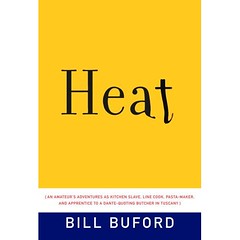
Book Review: Heat by Bill Buford

heat
Originally uploaded by Kit Pollard.
What could be more appropriate, at the height of summer misery and humidity, than to read a book called Heat?
And Bill Buford's book about his time working for and tracing the footsteps of uber-chef Mario Batali is, in fact, pretty hot - and in more ways than one. First, there's it's figurative hotness. It's all over the place these days, generating what can only be described as buzz (or, at least, what would've been described as buzz back in 1999). Piled on top of that is it's status as a mildly highbrow beach read. Buford's literary pedigree is unimpeachable (he's an editor at The New Yorker), making even the snobbiest readers feel right at home. But his story is insidery and gossipy enough to appeal to people more at home with the pulpier sort of non-fiction. Even fiction, really.
And then there's the real heat: what it feels like (literally) when the temperature is elevated way above 100. Buford eloquently describes a colorful cast of coworkers and mentors but, even better, he paints an amazingly detailed picture of what it feels like to work in a professional kitchen. The noise level (surprisingly quiet in Batali's kitchen), the movement and flow (just barely controlled chaos), the stress (lots of it) and, of course, the heat, which follows him from New York to Italy and back again.
I'd be lying if I said I wasn't a tiny big jealous of Buford, of his way with words and his access to some of the most influential and just plain entertaining people in the food industry. But I could never hold a grudge - I loved his book and am now busy recommending it to everyone I know - even the ones who aren't obsessed with cooking and eating.
Verdict: Totally recommended. So get it now. You know, while it's hot.
Friday, January 13, 2006
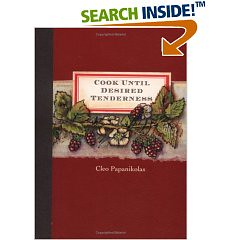
Book Review: Cook Until Desired Tenderness

cook until desired tenderness
Originally uploaded by Kit Pollard.
Late last week, after unsuccessfully hunting around Barnes & Noble for it, I ordered Cook Until Desired Tenderness from Amazon. I was hot to read the book because Cooking with Amy loved it, saying "If you crave a poetic mix of passion for cooking and cooking for passion, this slim volume is just the thing."
She compared it to Nick Bantock's Griffin and Sabine trilogy, the beautiful and captivating and so unusually designed story of London-based postcard artist Griffin and his star-crossed love, Sabine, a postage stamp designer in the Simeon Islands. The second I opened the first book in that trilogy, I was sold on Nick Bantock's unique and fascinating storytelling style.
But I digress. Back to Cook Until Desired Tenderness. As Amy says, it's a brief book, suited to a one-sitting read, and full of interesting, nearly Baroque illustrations surrounding the story of Sugar, a young woman exploring herself and her relationships through food.
The story is sweet and the illustrations are lovely. The name is appropriate - the story is told with a sort of tenderness. It's sort of a cozy book; it left me feeling rosy and warm after I read it. And in need of a good bowl of soup.
It wasn't, though, quite the same caliber as Nick Bantock's books. I don't want to sound as though I'm slamming it - I'm not - I really did enjoy it and if I had it to do all over again, I'd still buy it. But my expectations might have been set a little high.
Still totally recommended. And, though it's too late for Christmas, this book would make a fantastic gift.
Monday, January 09, 2006
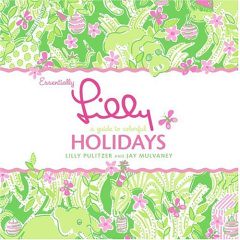
Book Review: Essentially Lilly: A Guide to Colorful Holidays

essentially lilly
Originally uploaded by Kit Pollard.
I have a confession to make. I am an uber-girly girl. Girly as in: full-on pink and green wedding (including a going-away dress made of eyelet), tulips all over my house whenever possible and an impressive collection of hair ribbons that I'd be wearing everywhere, everyday, if I was just a tiny bit younger.
As such, I loved Lilly Pulitzer and Jay Mulvaney's second Essentially Lilly book, this one devoted to Lilly's fabulous holiday celebrations. The stories are engaging, even if the writing's a little bit stilted, the old (and new photographs) are pretty and interesting, and the recipes are reasonably easy and appetizing. I'll make some of them, definitely, just as I've made some of the recipes from Lilly and Jay's first book.
So, if you are like me, and you like the pink and green, the stories of boozy, old-time parties and the beach, you'll probably also like this book - a lot.
On the other hand, if pastels make you slightly nauseous and you find subtle blue-blood name dropping more pretentious and annoying than pretentious and kind of charming, stay far, far away. Chances are, you won't be able to see past the sometimes blinding pink and green to the good, timeless recipes and entertaining suggestions.
But, in the interest of expanding your horizons, you might want to check it out. It's sunny, beachy, and might make you smile. Or not.
As for me, I smiled the whole way through. Occasionally, I rolled my eyes (like when Lilly says her great-uncle "owned half of Cooperstown"), but mostly, I smiled, affirming my belief in all things girly.
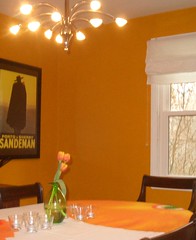
And speaking of girly, I picked up a new tablecloth yesterday. Isaac Mizrahi Home for Target. I've had my eye on it for quite some time...I must say, I think I like orange and green just about as much as pink and green:
dining room
Originally uploaded by Kit Pollard.