Showing posts with label connoisseurship. Show all posts

Thursday, June 07, 2007

Cool Things: Wine Edition

Over Memorial Day weekend, while I was recovering from my Friday night attempt to drink my weight in sangria (resulting in a new self-imposed "only one glass of sangria per evening" rule), I spent some time on the Internets reading about - what else - wine. I came across some cool things and thought I'd share them.

The whole quest for wine knowledge was kicked off by an email from Natalie MacLean, Canadian sommelier and food and wine writer extraordinaire. She pointed me in the direction of a very cool new tool available on her web site: a wine and food matcher. It's super easy to use and a great way to build a meal around a bottle or to find the best match for tomorrow's dinner. While it's necessarily limited - she can't possibly list every single food option imaginable - it's fun enough that I spent nearly an hour creating imaginary menus just so I could see what to drink with them. This is, apparently, what I do in lieu of playing video games.

Anyway, if you like Nat's site - and it is extensive - you can sign up for her newsletter, too.

A few days after talking with Natalie, I ran across this site - it's a blog and store that's all about wine without pretention or snobbery. The writing is awesome - funny and totally accessible - and I more than kind of wish I could meet the people behind the store. I also more than kind of wish Maryland would change it's ridiculous laws so I could actually buy some bottles from the store. Sigh.

The third and final cool new wine-related discovery is a little more philosophical. In a recent Slate article, Field Maloney looks at the societal implications and causes of the recent increase in the popularity of wine and corresponding decrease in the popularity of beer. It's not a long article and I found it absolutely fascinating - and completely resonant, too. I think that my husband might be the poster child for the new wine drinker.

Obviously, at our house, we enjoy the vino. Over the past couple of years, as we've become increasingly enamored by wine, we've gradually improved the quality of what we buy and have made an effort to collect some bottles that'll be really nice in about 15 years. We're into it. But that doesn't mean, for a second, that we have any desire to be highbrow about our new hobby. For one thing, almost all of the bottles we drink at home cost less than $15. Way less than $15.

Plus, at his core, Cooper is a little bit of a redneck. When he's not drinking wine, he's usually drinking Busch Light. On our first date, he actually said to me, "Yeah, I don't drink wine." And even now, he'll sometimes look at his glass (as he finishes his mock-Sideways tasting ritual) and he'll say, "I still can't believe I drink wine." Then he laughs.

Back to the article. My favorite part is this short passage:
The shape of American aspiration—our sense of connoisseurship and the good life,
the character of our nostalgias, even the thirst imperatives of a nation of
office clerks rather than line workers—has changed radically over the last few
decades in ways that have helped wine and hurt beer.

I've written here before about the nature of connoisseurship as it relates to food, but I hadn't thought of it as an integral part of what it means to be an American. It's true, though. My parents' and my generations haven't had to cope with a lot of day-to-day hardships. We've started out from a pretty good place. A decent education, the ability to find a good job, the opportunity to own a home - these are the traditional elements of the American Dream. When they're practically handed from you as a birthright, what comes next? How do you up the ante on that dream? Through hobbies and leisure activities. By becoming a connoisseur.

The article really deserves a full read, but I was also interested in Maloney's discussion of language and accessibility, of ritual and the pleasure at the table and of the advent of "lifestyle" as a marketing tool. It's given me a lot to think about. Naturally, I'm analyzing my own family's interest in wine through this lens.

I am my own best guinea pig, after all.

Wednesday, January 18, 2006

Matisse: The Un-Hedonist


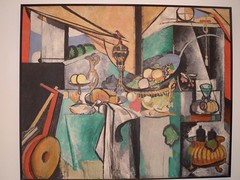
still life after la desserte 1
Originally uploaded by Kit Pollard.

It's been nearly a month since my sister and I visited New York, trolling the MOMA for her thesis and the rest of the city for my stomach. Just after the trip, I promised a few posts addressing the role of food in art - at least in a few specific works of art. In this, I have been remiss, and I am sorry.

As I've mentioned here before, I believe that people who truly love food are predisposed to also truly love other sensory experiences: art, fashion, music. I know that when I look at an amazing work of art, I get the same slight butterflies in my stomach as when I look over an exquisite menu, or hear my new favorite song for the first time.

I supposed I've always assumed, at least subconsciously, that the artists creating fine paintings, beautiful music, or elaborate and delicious meals are connoisseurs of their own, and other, disciplines. Surely, Thomas Keller's amazing creations are borne out of his love for not only food, but art as well.

Right? I mean, I'm no Thomas Keller, but when I stand over my stove, I'm thinking about taste and smell - and aesthetics.

But apparently this is not always the case, at least not for some artists who create their masterpieces outside of the kitchen.

Well before our trip, last August, actually, I read this Peter Schjeldahl New Yorker article about Hilary Spurling's two-volume biography, A Life of Henri Matisse. The article focuses mainly on the second volume of the set, Matisse the Master: Conquest of Colour, which focuses on the second half of the artist's life, from 1909 until his death in 1954.

The article is beautifully written and well worth a read. Schjeldahl weaves Matisse's tempermental, aloof personality with his dysfunctional relationships, explaining how such a complicated and often unhappy character could create works of art so pure and delightful. Schjedahl boldy and, I think, correctly, says of Matisse's body of work,

"Anyone who doesn't love it must have a low opinion of joy."

This dichotomy begins to jar my theory. As a creator of joyous work, like the vibrant still life above (Still Life after La Desserte, 1915), shouldn't Matisse be a connoisseur of all things sensory? Apparently not.

Spurling, the biographer, describes Matisse as something of the opposite of Picasso's hedonist. He wasn't ascetic - he slept with many women, for example - but he didn't seem to enjoy it.

But to a foodie like me, the most jarring sentence of Schjeldahl's article comes towards the end:

"according to Matisse, he never ate even the fresh food that he used for still-lifes including oysters, from a restaurant in Nice, that were returned in time for the lunch crowd."

He painted the food, he celebrated it, he shared it with the world, but he never enjoyed it himself? He didn't eat it, even when it was right there in front of him? And oysters, too!

It was with this quote in mind that I found myself staring at the painting above, and
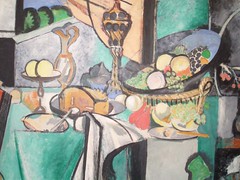
specifically, at the food depicted in it's center:


still life after la
desserte 2

Originally uploaded by Kit Pollard.


So there I stood, in the middle of the MOMA, after accidentally breaking the rules - twice - by taking flash photos, that I realized...

Sometimes I have no idea what I'm talking about. I can't even remotely presume to know what goes on in the mind of the genius.

But still - and this is the last I'll say on the subject - although Matisse didn't depict his food with the mouth-watering, succulent clarity of, say, the French Laundry Cookbook, his particular style somehow lights the food from within. While when I look at his fruit, I can't taste the juice of orange, I can, somehow, imagine the pleasure that eating that orange would bring. The joy.

And that brings me back to wonder: how is it possible for someone who denied himself simple pleasures like food, who purported not to enjoy those pleasures - how could he so aptly communicate them?

Monday, December 05, 2005

More on Food and Fashion

Virginia Postrel, like the Manolo, knows about style. She's written a book called The Substance of Style and looks at aesthetics from an intellectual angle that appeals to the research analyst in me. Recently, on her blog, she defined fashion this way:
In TSOS, I define fashion as aesthetic changes purely for their own sake,
without underlying functional reasons. (You could broaden that definition to
change for change's sake.) Fashion in this sense isn't limited to personal
appearance.

At first glance, "change for change's sake" could be applied to food trends, both the aesthetic (shoving all types of food, even salad, into the dreaded ring) and the culinary (pasta in the 80's, the ubiquity of, say, sundried tomatoes today). Sort of.

This definition of fashion might be too narrow for my taste. While no one will convince me that there's functional value in presenting food in a squishy cone shape, the very nature of food makes it difficult for me to separate function from the other qualities of food.

I'll use the 80's pasta phenomenon as an example. It absolutely had the elements of a trend, of faddish food - it was everywhere all at once, infiltrating California restaurants the way jelly bracelets overtook my elementary school. But was it purely function-free?

The answer to that question is yes, in that pasta does not necessarily improve upon other foods in terms of actual nourishment. But the answer is no if food is not a black and white subject, which I'd like to think it's not. First, there are the health benefits of pasta over other traditional restaurant foods. And, less tangibly, the benefits of taste. People liked the taste.

In this case, I suppose taste might be reasonably compared to people liking the look of, say, skinny pants one season. Or, as Postrel mentions, the sound of a certain baby name. Postrel explains that subcultures tend to unconsciously adopt certain new fashions, all at the same time. So it fits that the taste of pasta dishes would blossom, resulting in thousands of successful restaurants.

But my question is: isn't food different? Isn't taste - actual, literal taste that happens with the tongue - somehow less subjective than taste in clothing or baby names? Shouldn't culinary trends be somehow more connected to nourishment - to function?

And the answer is...I have no idea. Our likes and dislikes in terms of food are learned, which suggests that my revulsion at storebought mayonnaise is no more logical or objective than the way I cringe at acid-wash. At the same time, objections to food are so deep-seated that often they are difficult to change. Hearing a new baby name over and over again or seeing a new style on a thousand models help the brain become accustomed to something new without much conscious effort. But in this case, food is different. We must make the choice to try something new.

All of this is a long-winded way of saying that I'm not sure if I agree with Postrel's definition of fashion, at least when it comes to food. Then again, I'm not sure I entirely disagree either. I'm not sure where "function" begins and ends when it comes to food, and I'm not sure how changes in food trends are adopted. But it does give me a lot to think about.

Thursday, December 01, 2005

On Fashion and Food

I’ve been a devotee of Manolo the Shoeblogger for well over a year now, ever since he posted his first treatise on the love of shoes, in all their superfantastic glory. While he is, officially, an anonymous blogger, he’s never been shy about sharing his likes and dislikes with his adoring readers. So I’ve known for quite some time that the Manolo, he is “something of a gourmand.”

This week, he suggests Jose Andres' Tapas: A Taste of Spain in America as a holiday gift. I haven’t read the cookbook, so I can’t personally comment on it, but I have read about the author and he sounds fantastic, both entertaining and knowledgeable. But this is not what this post is about.

When I read the Manolo’s post, I started thinking about the connections between food and fashion. True, there are foodies who pay next to no attention to their appearances, and there are certainly many fashionistas who shun the food (the evils of the fashion industry that spawn those attitudes belong to another post entirely.) But really, the intersection between those who love food and those who love fashion is large, and understandably so.

Appreciating both fashion and food is, at its core, about responding to the sensory qualities of a basic human need. About elevating those needs, taking them beyond the minimum requirements for survival.

When I see a great dress, or a perfect pair of shoes, my body reacts. Appreciation (and, being honest, wanting) bubbles up – literally, I start to feel fizzy, like I’ve been drinking champagne.

The same is true for food. At my first glimpse, or scent, of truly desirable food, whether that means a multi-course meal or a single, pristine wedge of cheese, I feel the same bubbles, the same fizz. Because for me, and for many other people (I think), great fashion and great food are much the same. They meet needs on a basic level, but go so much further.

(This is probably true for anyone who, like I do, believes in the transcendent quality of cooking and eating I wrote about last week.)

On that note, as I listen to the Food Network as background noise, I can't help but think: Barefoot, she is like Coco Chanel. Rachel Ray (who's voice is currently attacking my ears), more like Kathie Lee Gifford. And Emeril, well I just don't know. BAM!

UPDATE: Aiiiyyyyyy! The Manolo, he has linked to this post. His thoughts are insightful, as usual, and take my comments to the next level. His un-snooty connoisseur is the type of person I hope to one day become (one day when I have much more experience with food, fashion, art, and a number of other fields). Welcome, Manolo readers! And thank you, Manolo!

LinkWithin

Related Posts with Thumbnails